Why is it so easy to check social media every morning, but so difficult to maintain a simple running or walking routine?
Behavioral designers like B.J. Fogg and James Clear have proved that habits require a cue, a craving, a response, and a reward. If any of these components are missing or weak, the habit loop breaks.
For most fitness activities, the reward is either too far in the future (weight loss, improved cardiovascular health) or too abstract (a numerical chart on a phone screen). To bridge this gap, we must look to a fundamental aspect of human psychology: the need to be seen and recognized.
What is the psychological link between visibility and habits?
In behavioral psychology, the concept of "social validation" is one of the strongest drivers of human behavior. When we perform an action and receive immediate, positive feedback from our environment, our brain releases dopamine, locking in that behavior.
When your fitness efforts are entirely private, the feedback loop is weak. You run 5 kilometers, save the workout, and close the app. The external world remains unchanged.
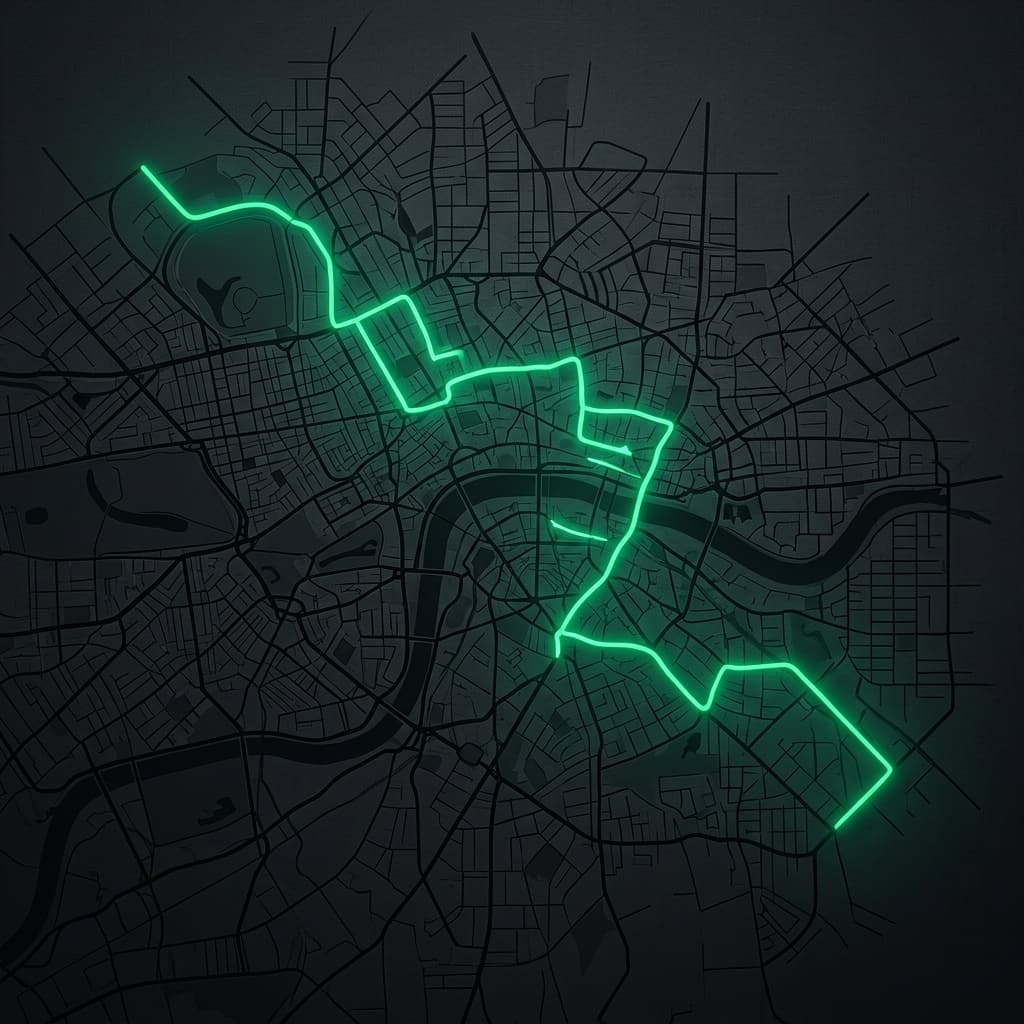
However, if your physical effort is made visible—if your run leaves a temporary, glowing route on a live map of your neighborhood—your perspective changes. Your action has a tangible impact. You are visible. The psychological feedback is immediate: I showed up, I made a mark, and my community can see that I am active.
This visibility directly affects your self-concept. You stop thinking "I am trying to run" and start thinking "I am a runner who contributes to the activity of my neighborhood." Once an activity is tied to your identity, habit consistency becomes automatic.
How does the 'audience effect' improve exercise consistency?
In social psychology, the Audience Effect describes the phenomenon where individuals perform tasks differently when they know they are being observed. In a fitness context, knowing that your efforts are visible to others creates a healthy, ambient form of accountability.
This is not the high-pressure accountability of a personal trainer or a group class. It is the ambient knowledge that you are part of a visible movement.
When you see other glowing lines on your neighborhood map in Bandra or Shivaji Park, you realize you are part of a larger, active ecosystem. And when you run, you know that your route is adding to that active glow. This collective visibility acts as social proof. It normalizes consistency, creating a subtle positive social pressure to keep your streak alive.
Why do private rewards fail to create long-term routines?
Most people try to build consistency using private, transactional rewards: "If I run today, I can eat a cheat meal" or "If I hit my target, I will buy new gear."
These rewards fail for two reasons:
- Hedonic Adaptation: The pleasure of the reward quickly fades, requiring a bigger reward next time to achieve the same effect.
- Lack of Identity Integration: Private rewards do not change how you perceive yourself. They treat the exercise as a punishment that deserves a prize.
Public recognition, however, is a non-transactional, identity-based reward. Being recognized by your peers as a consistent, active member of your community feeds our evolutionary need for status and belonging. This makes the habit self-sustaining. You run because you want to maintain that identity, not because you want a reward.
How can ambient recognition build better urban fitness spaces in India?
Urban cities in India—like Mumbai, Delhi, Bengaluru, and Pune—have unique challenges when it comes to fitness. Space is limited, traffic is heavy, and weather can be extreme.
When we make fitness efforts visible, we create virtual community hubs. We don't need physical clubhouses to connect. A live, glowing neighborhood map becomes our shared space. It shows us where people are active, when the streets are safest, and which loops are the most popular.
This digital visibility creates physical safety and social cohesion. It transforms an individual, isolated workout into an active neighborhood movement.
By understanding the psychology of habit consistency, we can design tools like REVO that focus on presence, visibility, and community over stats and isolated leaderboards.
Frequently Asked Questions
What is the psychology of habit consistency?
Habit consistency is driven by identity integration and social proof. When an activity becomes a part of how you view yourself and how your community views you, maintaining it requires very little willpower.
How does social validation help in working out?
Social validation triggers the release of neurotransmitters like dopamine and oxytocin, which associate exercise with feelings of belonging, status, and positive reinforcement.
Why is competition less effective than visibility for habit building?
Competition creates pressure and alienates beginners who feel they cannot compete. Visibility focuses on presence and consistency, celebrating the act of showing up rather than the speed or performance.
Ready to make your consistency visible? Join the REVO movement on our homepage and secure your spot today.